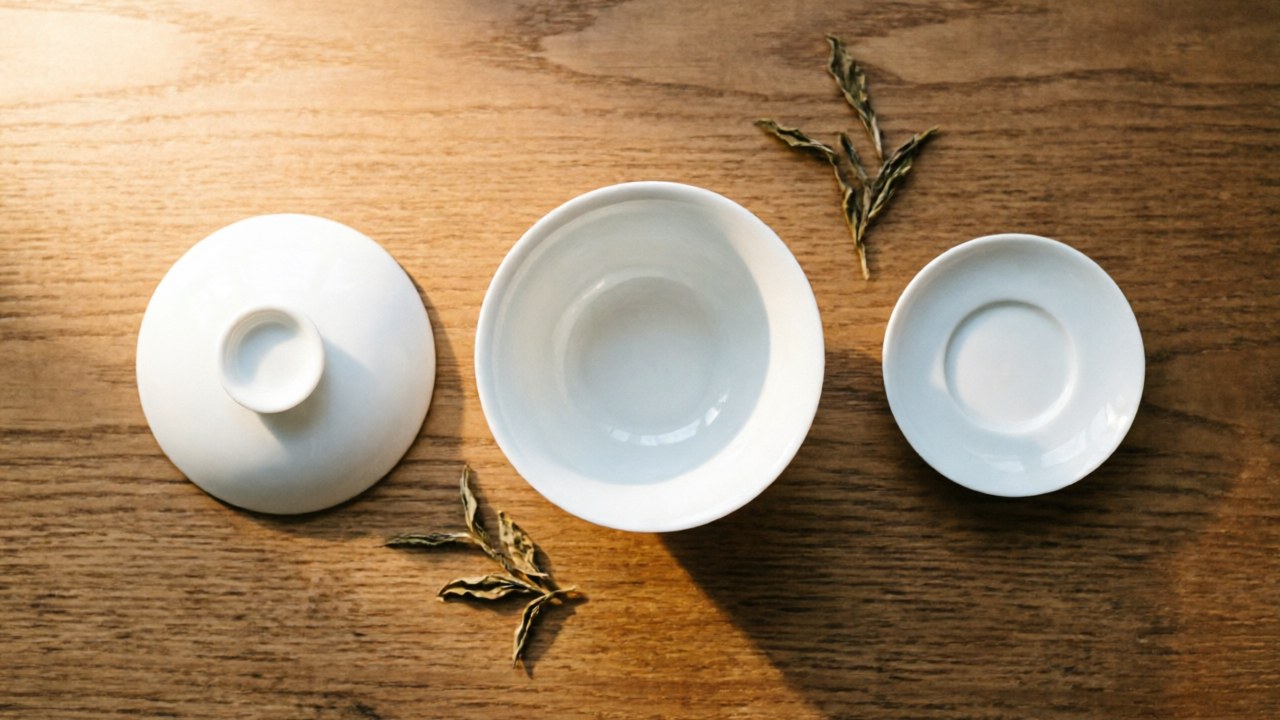
The gaiwan’s three-part form - lid, bowl, saucer - has remained largely unchanged for 600 years [1]. But the proportions shifted with every dynasty, every kiln, every shift in how tea was drunk. This is not a timeline. It is a form-study guide: what to look at, what the shapes tell you, and why the proportions still work for the teas you drink today.
From Bowl-on-Plate to Three-Part Form
During the Tang Dynasty (618-907 CE), tea was drunk from a bowl that sat on a saucer for stability [1]. The saucer wasn’t philosophical yet - it was a practical solution for handling hot bowls. A Tang general’s daughter, Cui Ning, is credited with adding a stabilizing saucer ring to prevent the bowl from sliding [4].
The real shift came in 1391, when the Ming court abolished compressed powdered tea and ordered a switch to loose-leaf brewing [1]. This changed everything about the vessel. Loose leaves float. They need containment. The lid was the innovation that answered this: it kept heat in, held back floating leaves when pouring, and turned a drinking bowl into a brewing vessel.
That lid is what separates a gaiwan from every bowl that came before it. The bowl-on-saucer had existed for centuries. The lid made it a tool. For a deeper historical reference, The Ancient Art of Tea collects wisdom from old Chinese tea masters who documented this transition [1].
Anatomy of a Gaiwan: Lid, Bowl, Saucer
The three parts carry a philosophical name: sancai (三才), meaning “three talents” [2].
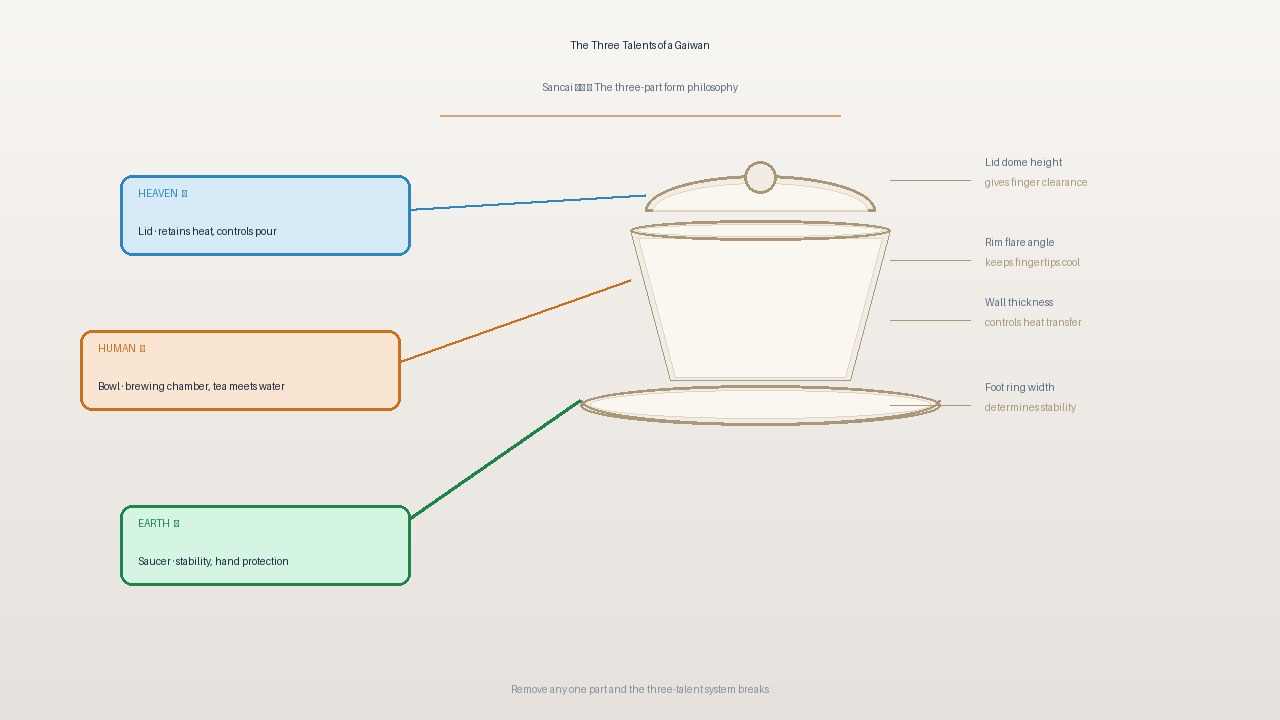
The lid (天, heaven) retains heat, strains leaves, and controls the pour. Tilt it slightly and you create a gap - the width of that gap determines how fast tea exits and how much leaf stays behind. Lid dome height is functional, not decorative: a taller dome gives you more grip room when lifting.
The bowl (人, human) is the brewing chamber. Bowl depth and flare angle determine two things: pour speed (deeper bowls pour slower) and finger heat (wider flare keeps your fingertips off the hot wall). The bowl is where tea meets water - the human element in a system of heaven and earth.
The saucer (地, earth) provides stability and protects the hand from heat. Saucer rim width matters more than people realize: a wider rim cradles the bowl securely, while a narrow rim lets the bowl wobble.
Remove any one part and the system breaks. Without the lid, you’re drinking Tang-style. Without the saucer, you’re holding a hot bowl. Without the bowl, nothing exists. A Jingdezhen porcelain gaiwan is a good study piece for observing this three-part relationship without committing to clay [3].
Regional Styles: Jingdezhen, Yixing, Chaozhou
Three regions shaped the gaiwan’s form, each driven by the tea its drinkers preferred - not by aesthetics alone.
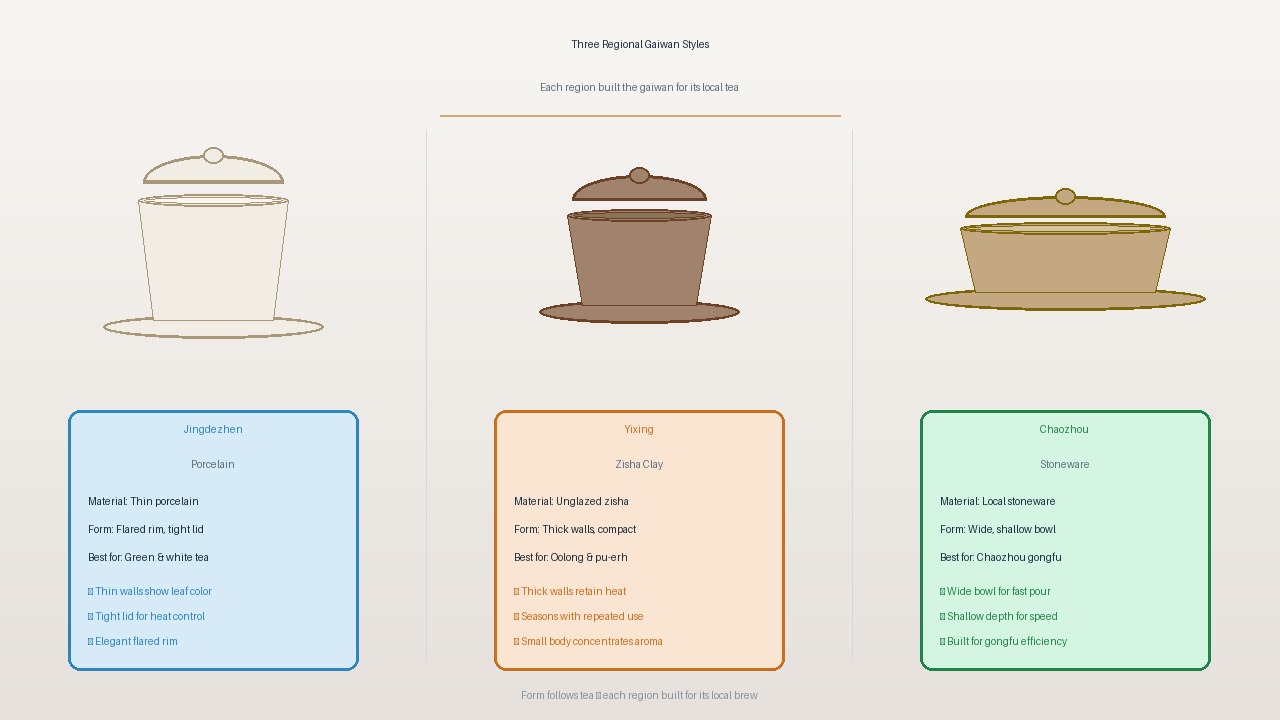
| Region | Material | Form tendency | Built for |
|---|---|---|---|
| Jingdezhen | Porcelain, blue-and-white | Thin walls, flared rim, tight lid | Light teas - green, white [3] |
| Yixing | Zisha clay, unglazed | Thicker walls, smaller, rounder | Oolong, pu-erh heat retention [3] |
| Chaozhou | Local stoneware | Wider bowl, shallower | Chaozhou gongfu fast pour [5] |
Jingdezhen’s thin porcelain walls let you see leaf color through the bowl. The tight lid traps delicate aromas. A blue-and-white mountain-style gaiwan shows the classic Jingdezhen flared rim and painted decoration that defined the Ming-Qing aesthetic [3].
Yixing zisha clay absorbs heat slowly and releases it evenly - thicker walls aren’t a flaw, they’re the point. An Yixing zisha gaiwan shows the compact, rounded form that holds temperature for repeated oolong steeps [3].
Chaozhou stoneware gaiwans run wider and shallower. The shape serves Chaozhou gongfu style, which pours fast and often - you need a wide bowl to decant quickly without splashing [5].
The form followed the function. Regional tea culture didn’t just decorate the vessel - it determined the proportions.
Porcelain vs Clay: What the Material Tells You
Porcelain is the study-first material. I keep a plain porcelain gaiwan on my desk for daily leaf observation - it’s neutral, doesn’t absorb flavor, shows leaf color, cleans easily, and costs $15-20 for a clear study piece [3]. A glass gaiwan goes one step further - you can watch leaves unfurl from the side, which is form study in real time.
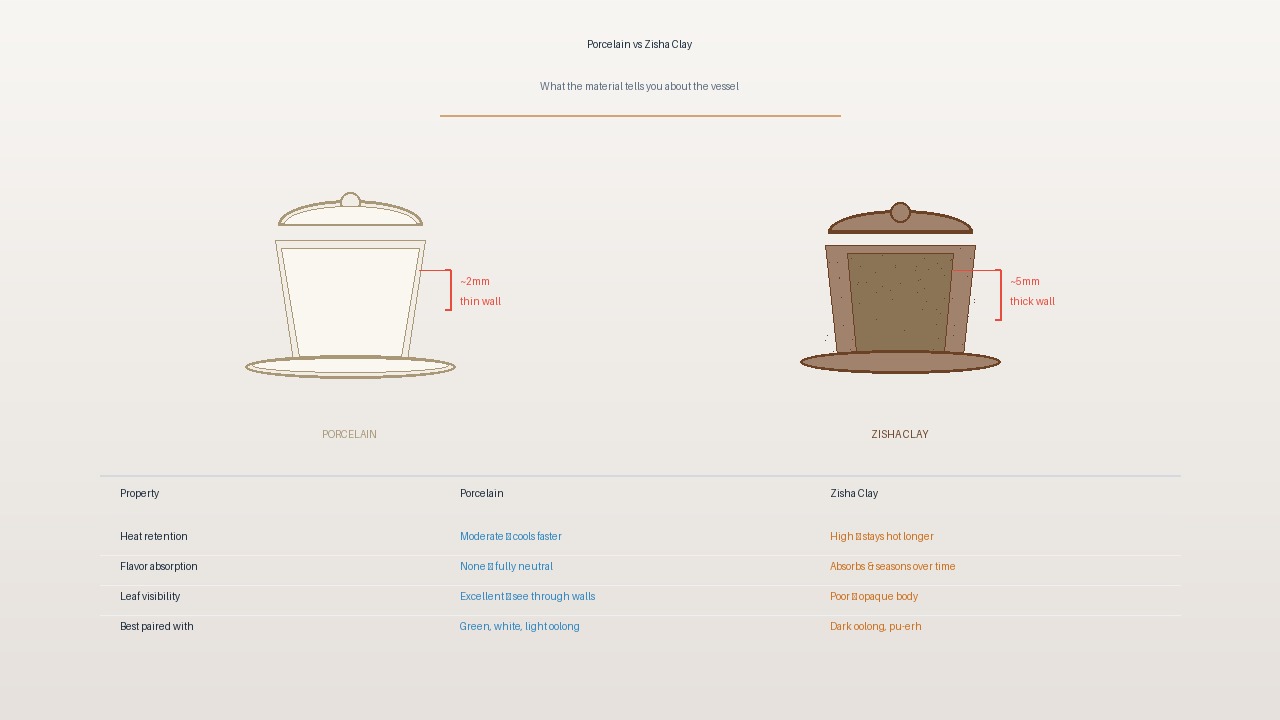
Clay is the upgrade path, not the starting point. Zisha retains heat, seasons with use, and rewards the one-tea-one-pot principle. But clay hides the leaf color, absorbs aromas, and costs more. You don’t need clay to study form - you need it when form study is over and you’re brewing the same oolong every day [3].
For broader context on how material shapes tea culture, All the Tea in China covers Chinese tea methods and material traditions [3].
The material decision is separate from form study. You can train your eye on a $15 porcelain gaiwan before ever touching clay.
How to Look at a Gaiwan Today: Eye-Training Checklist
This is eye training, not buying advice. The point is to develop form vocabulary before spending money. Take any gaiwan and work through these five checks:
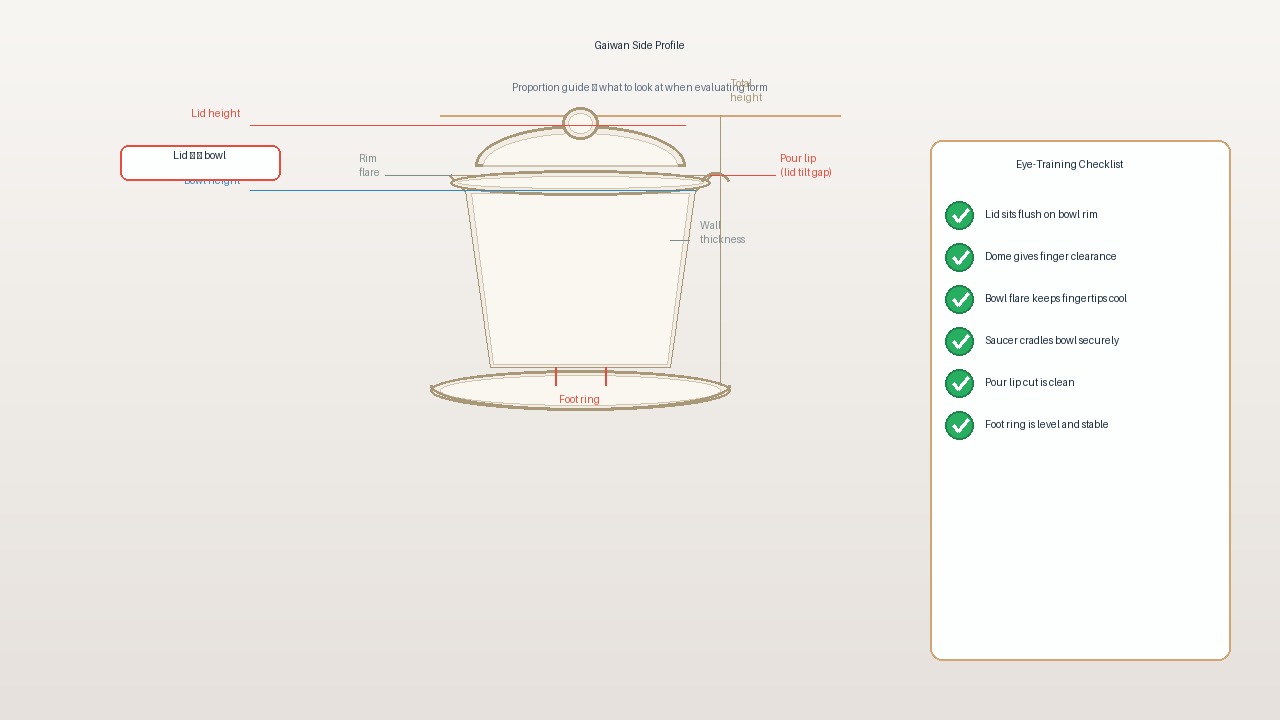
- Turn to a pure side profile - does the lid sit flush on the bowl or float above it? A lid that sits flush is a tighter heat seal. Classic lid-to-bowl height ratio is roughly 1:3 [3].
- Look at the pour lip - is the rim cut clean or flared outward? A clean cut gives a thin, controlled pour. A flared lip pours faster but with less precision.
- Check the foot ring - a wide foot means stability. A narrow foot looks elegant but tips more easily on an uneven tray.
- Feel the rim - does the bowl flare enough to keep your fingers off the hot wall? A rim that curves outward gives you a cool grip edge.
- Test the lid knob - is it tall enough to lift without burning your fingers? A flat knob looks clean but gives you no grip when the lid is hot.
For deeper context on how these proportions evolved, A History of Tea traces tea vessel evolution from Tang to modern practice [3].
When Study Becomes Buying
If you’ve studied form and want to buy, here’s the transition path:
- Start with porcelain - neutral, study-friendly, $15-20. The Jingdezhen gaiwan remains the benchmark study piece.
- Add glass if you want to watch leaves unfurl - a glass gaiwan is observation, not decoration.
- A tea tray makes study sessions cleaner - an Eorbow wooden tray gives you a surface that handles spills.
- Upgrade to clay only when you know which tea type you’ll brew repeatedly - zisha is commitment, not a first purchase.
When study turns into a buying decision, the how-to-choose gaiwan guide covers size, lid fit, and daily-use trade-offs.
Where This Page Sits
This article lives in the Appreciate lane of Teaware. It isn’t a buying guide - that’s how-to-choose-gaiwan. It isn’t a ceremony manual. It is form study for the curious mind.
- Hub: Fine vessels worth studying
- Personal system: Teaware personal system
- Sister studies: Classic Yixing forms · Chawan lineage · Jianzhan (planned)
- Related: Teaware for tasting · Teaware care
Dynasty-by-Dynasty Form Timeline
The gaiwan’s shape didn’t appear fully formed — it evolved across three major eras:
Ming Dynasty (1368–1644): The covered bowl emerged as a practical alternative to the whisked-tea bowls of the Song. Early forms were wide and shallow, with a simple lid that kept dust out and heat in. The rim was often unglazed for grip. Think of these as the prototype — functional but without the refined pour lip or the tight lid-seat that later eras perfected.
Qing Dynasty (1644–1912): The form we recognize today took shape. Potters at Jingdezhen narrowed the waist, raised the foot, and refined the lid-to-bowl seal. The sancai (three-piece: lid, bowl, saucer) arrangement became standard — symbolizing heaven, earth, and humanity. Export gaiwans of this period often featured famille rose or celadon glazes commissioned for European collectors.
Modern (1912–present): Factory production standardized sizes (the 150ml benchmark comes from this era). Contemporary potters experiment with glass, double-wall designs, and ergonomic rims that address the finger-heat complaints of daily users. The form remains instantly recognizable across 600 years — a testament to how well the original proportions work.
Today’s Observation: Look at Your Own Gaiwan
Pick up any gaiwan you own. Look at three things:
- The waist. Is it pinched (Qing influence) or straight-walled (Ming influence)? Most modern gaiwans blend both — a gentle curve rather than a sharp waist.
- The lid knob. Is it low and wide (modern minimalism) or tall and narrow (traditional)? The knob height tells you about the potter’s priorities — heat protection vs. visual profile.
- The foot ring. A trimmed, unglazed foot ring shows the potter finished the piece by hand. A molded foot with glaze all the way through indicates factory production. Neither is better — they’re just different stories.
For more on how to observe classic teaware forms, see our guide on classic Yixing forms.
The Mind of the Gaiwan
The gaiwan is a quiet object. Three parts, no mechanism, no spout. Yet 600 years of tea-drinking culture compressed into a form that still works: lid to hold heat, bowl to brew, saucer to protect the hand. Study the proportions before you study the price. The form has outlived every dynasty that shaped it [1].
References
[1] Gaiwan - Wikipedia, https://en.wikipedia.org/wiki/Gaiwan [2] Teasenz.eu - “What Is a Gaiwan? It’s Not That Simple…”, https://teasenz.eu/blogs/tea-magazine/what-is-a-gaiwan [3] ZenBrew Tea Studio - “The Origin and History of Gaiwan”, https://zen-brew.com/blogs/teaware-appreciation/the-origin-and-history-of-gaiwan [4] Teaphile - “Gaiwan: Part 1”, https://teaphile.com/blogs/tea-talk/盖碗-gaiwan-part-1 [5] Gongfu Tea - Wikipedia, https://en.wikipedia.org/wiki/Gongfu_tea