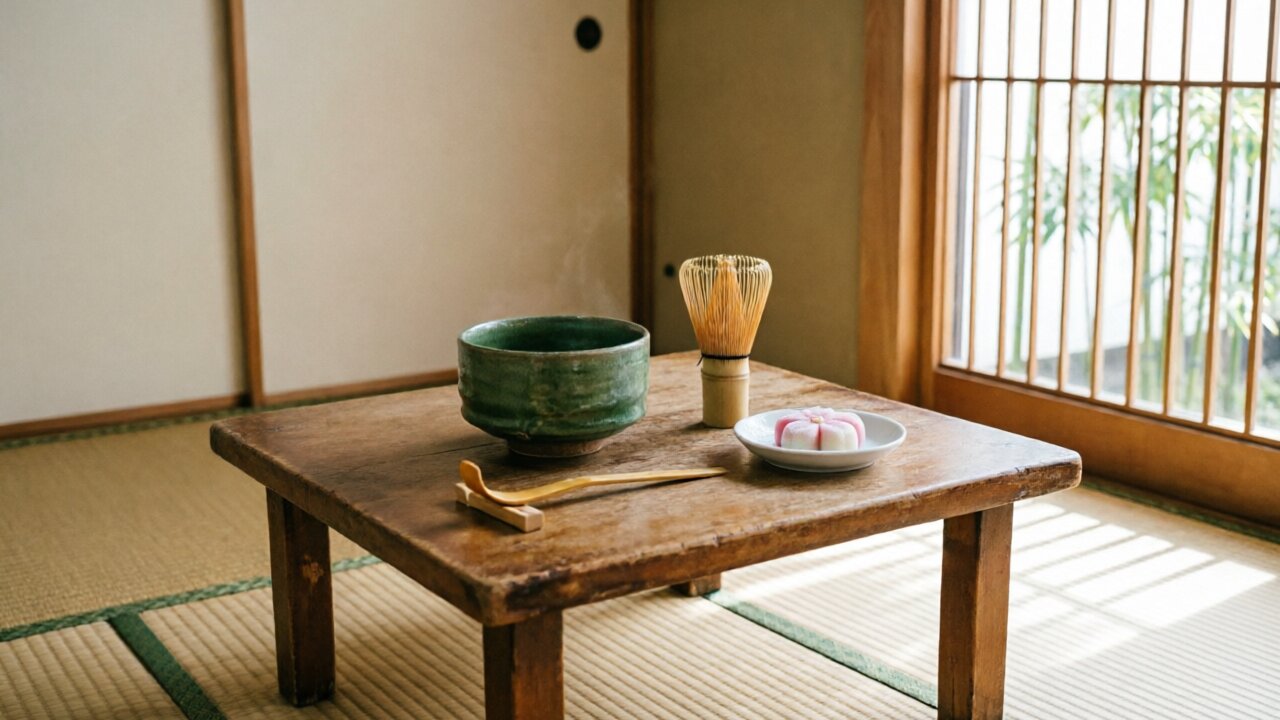
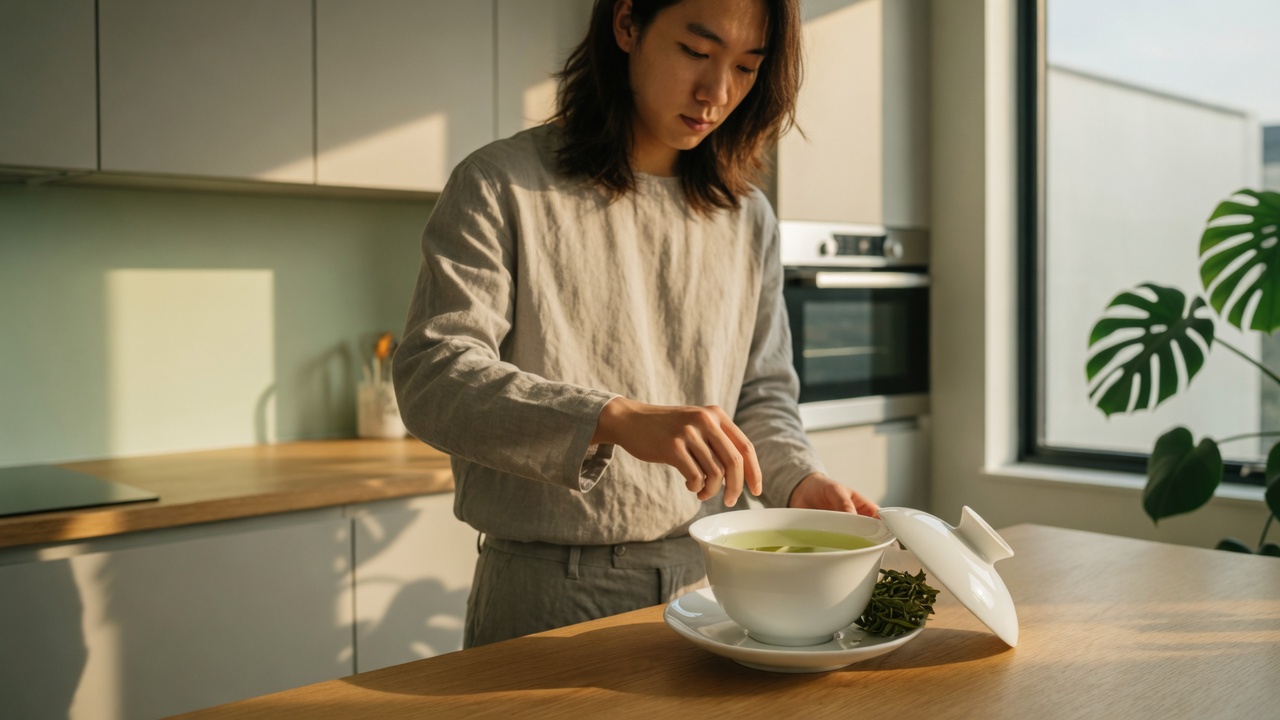
Japanese matcha ceremony — chanoyu, “hot water for tea” — looks from the outside like a sequence of small, slow gestures. Inside, it is a discipline built on four principles that govern how the host moves, pours, listens, and offers. The ceremony is older than the matcha powder most people drink today, and the practices around it are why matcha is associated with calm rather than caffeine jitters [1].
This guide is a Practice rail on the Ceremony hub: what the ceremony is, where it came from, the four principles that hold it together, and a six-gesture home version you can run in a modern kitchen. It is not the full Chado system page (schools, room, lineage) — that lives under Traditions when published. For powdered-tea context (grades, production, caffeine), start with the matcha variety guide and caffeine by tea type.
What the Four Principles Mean
The Japanese tea ceremony is governed by four principles, written as a single compound in Japanese: wa-kei-sei-jaku — harmony, respect, purity, tranquility [2].
Harmony (wa) is about the room, the host, the guest, and the season all being in agreement. The host picks the tea, the flowers, and the scroll to fit the weather and the people. A summer gathering calls for a thinner tea and a lighter sweet; a winter one, the opposite. This is not decoration — it is the host’s way of saying I see you, I see the day.
Respect (kei) shows up in small gestures. The bow when you receive the bowl. Turning the bowl twice before drinking so the front faces away from you (the maker’s mark stays toward the host). Setting the bowl down with both hands. None of these gestures are performed for an audience — they are the visible form of a particular kind of attention.
Purity (sei) has two meanings. The literal one is physical cleanliness: the host rinses each tool in front of the guest before using it. The deeper meaning is the cleaning of the heart. The preparation of the room, the wiping of the ladle, the careful folding of the cloth — these are the host’s way of putting aside the day’s noise so that the only thing remaining is the tea.
Tranquility (jaku) is the result, not a starting posture. You do not arrive at the ceremony calm. The ceremony produces calm, by the time you finish, if the host has done the work and the guest has allowed it.
A Brief History
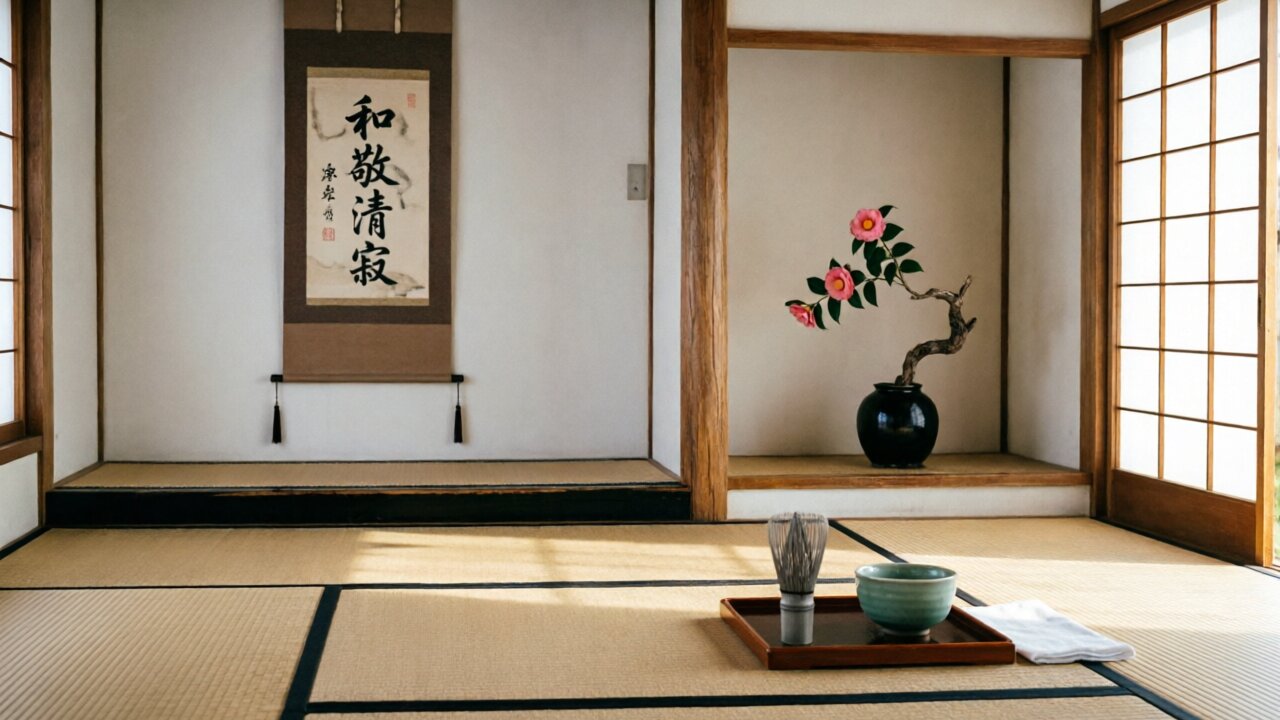
The ceremony has roots in two streams. Powdered tea itself arrived in Japan from Song Dynasty China in the late 12th and early 13th centuries, brought by monks who had studied in China and valued tea as a meditation aid [1]. For several centuries it remained largely a monastic and aristocratic drink.
The form we now call chanoyu — the choreographed ritual, the tatami room, the codified principles — was shaped in the 16th century by Sen no Rikyū, a merchant and tea master who served Oda Nobunaga and later Toyotomi Hideyoshi. Rikyū distilled a sprawling aristocratic entertainment into something smaller and stricter: a four-and-a-half-mat room, a simple iron kettle, a single flower, and an ethic of rusticity over display. He codified wa-kei-sei-jaku as the four principles. The three main schools of tea ceremony today — Urasenke, Omotesenke, and Mushakōjisenke — all descend from Rikyū’s students [2].
Modern Japanese schools still teach the full formal version in dedicated classrooms. What most non-Japanese people encounter is the everyday version: a host and one or two guests, in a room or a kitchen, performing the same gestures more quickly and without the kaiseki meal. The principles are the same. For how matcha is grown, processed, and graded, the matcha variety guide covers the production chain the ceremony draws from; for vessels and whisks, see matcha tools.
A Practical Home Version
The full formal ceremony takes years to learn and decades to perform well. A home version that captures the spirit takes about ten minutes and the same tools you would use for a daily matcha.
What You Need
- A chawan (matcha bowl), roughly 12 cm or wider across the top — kit bowls work; a wider everyday option is the Jade Leaf Matcha Porcelain Bowl with Pour Spout
- A chasen (bamboo whisk), 80 prongs or more
- A chashaku (bamboo scoop)
- A fine-mesh sifter
- Fresh matcha for bowls you will drink, such as Naoki Matcha Superior Ceremonial Blend 40g — see matcha grades for ceremonial vs culinary
- Hot water at about 80 °C — a Cosori Gooseneck Electric Kettle with Temperature Control makes that repeatable
- Optional complete kit: the Hario Matcha Tea Set (Clear) – Double-Walled Glass Matcha Bowl with Chasen Whisk bundles bowl, chasen, sifter, and chashaku in one box
The Hario kit chawan runs smaller than many standalone bowls. If the whisk feels cramped after a week of practice, step up to the Jade Leaf bowl above or a handcrafted option such as the Mino Ware Japanese Handcrafted Chawan (Yuki Shino). For a full breakdown of which tools matter and why, see the matcha tools guide. Leaf ratios and latte parameters stay on Brewing and the matcha latte recipe — this page keeps ritual sequence, not a full parameter table.
The Steps
A simple version of the ceremony follows six gestures. Each one is the same in every school; only the speed varies.
-
Wipe the bowl. Even if the chawan is already clean, the host wipes the rim and outside with a clean cloth before the guest arrives. This is the visible form of purity.
-
Warm the bowl. Pour hot water into the bowl, swirl once, and discard. The warmed bowl holds the matcha temperature better.
-
Sift the matcha. Use the chashaku to measure roughly two grams from a tin such as Naoki Matcha Superior Ceremonial Blend 40g. Hold the sifter over the dry bowl and tap once. The clumps break; the powder falls evenly.
-
Add 80 °C water. Pour about 60 ml slowly along the inside wall of the bowl. With a Cosori Gooseneck Electric Kettle with Temperature Control, set 80 °C once and stop guessing. The water should feel hot to the touch — about the temperature of a comfortable bath.
-
Whisk. Hold the chasen vertically. Press the bristle tips to the bottom of the bowl. Trace a slow M or W motion for about fifteen seconds. The surface should turn from glossy to a fine, even foam. Stop when the foam has the texture of soft shaving cream. If you are still learning foam on a budget powder, Jade Leaf Organic Culinary Grade Matcha is enough for practice bowls.
-
Offer and receive. Lift the bowl with both hands. Rotate it twice so the front of the bowl faces away from you. Offer with a small bow. When you receive a bowl, do the same in reverse: rotate it once or twice so the front faces you, then drink.
Common Mistakes
The most common failure is rushing the whisk. A fast whisking motion produces larger bubbles and uneven foam — the surface looks foamy but the cup underneath has unmixed powder. Slow is faster than fast here.
The second is overfilling the bowl. The traditional ratio is two scoops (roughly 2 g) to 60 ml of water. A bowl that looks half-empty at the start is correctly portioned; a bowl filled to the brim is two servings, not one.
The third is using water that is too hot. Boiling water scorches matcha and produces a bitter cup. If you do not have a temperature-controlled kettle such as the Cosori Gooseneck Electric Kettle with Temperature Control, boil the water and wait ninety seconds before pouring.
The fourth is skipping the rotation. Turning the bowl before drinking is not etiquette for its own sake. It is a small gesture that puts the maker of the bowl (and the host) in a particular orientation toward the guest — and it signals, before the first sip, that this is a shared act rather than a private one.
Modern Practice
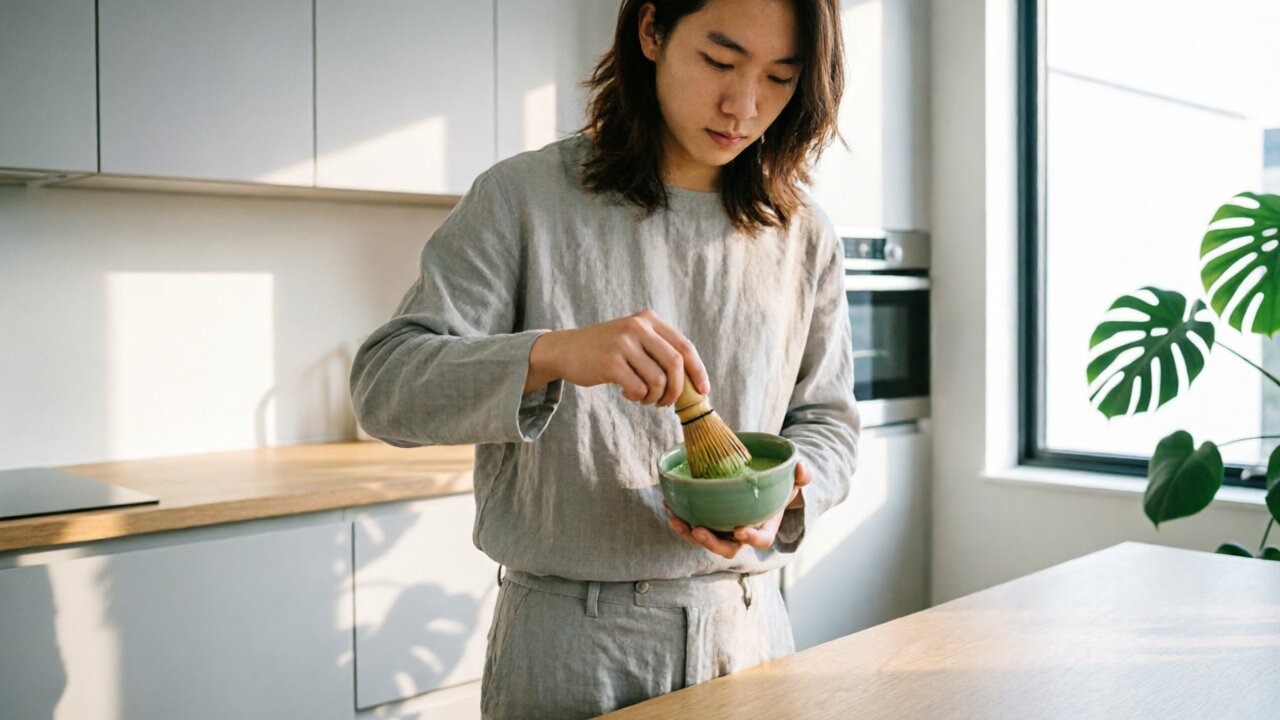
Most practitioners today do not perform chanoyu the way Rikyū’s students did. They do a daily solo matcha with the same structure. The room is a kitchen counter, the guests are absent, and the kaiseki meal is skipped. The gestures are the same — wipe, warm, sift, pour, whisk, lift — and the principles still apply, because the principles are not about the room. They are about the host.
A solo daily practice works best at a fixed time. Morning is common, because the matcha acts as a focus anchor for the day ahead. The point is not the caffeine; it is the structure. Six small gestures, done slowly, that interrupt the day’s momentum for the time it takes to drink a cup of tea. When you return to the day, the attention you built during those ten minutes tends to follow. For how powdered green tea sits on a caffeine map next to other teas, see caffeine by tea type.
If you want a slightly less formal everyday version that produces something closer to a café matcha latte, the matcha latte recipe follows related preparation ideas with steamed milk added at the end. Keep formal sequence here; keep milk ratios there.
The matcha itself matters less than people expect. A daily-grade tin such as Jade Leaf Organic Culinary Grade Matcha works while you learn. The formal ceremony uses ceremonial-grade matcha because the host chooses each element to fit the moment — for a solo practice, what you actually like drinking is the right answer. When the habit sticks, keep a small ceremonial tin such as Naoki Matcha Superior Ceremonial Blend 40g for bowls you will drink slowly.
Recommended tools for a home sequence
Soft-sell only — named tools that make the six gestures repeatable, not a product course. Full vessel chooser lives on Teaware and matcha tools.
| Role | Tool | Why it helps the sequence |
|---|---|---|
| Complete starter kit | Hario Matcha Tea Set (Clear) – Double-Walled Glass Matcha Bowl with Chasen Whisk | Bowl, whisk, sifter, scoop in one workflow |
| Wider everyday bowl | Jade Leaf Matcha Porcelain Bowl with Pour Spout | More whisk room than many kit bowls |
| Handcrafted bowl | Mino Ware Japanese Handcrafted Chawan (Yuki Shino) | When practice becomes a habit |
| Ceremonial tin | Naoki Matcha Superior Ceremonial Blend 40g | Fresh small tin for 1–2 g bowls |
| Practice powder | Jade Leaf Organic Culinary Grade Matcha | Lower cost while you learn foam |
| Temperature control | Cosori Gooseneck Electric Kettle with Temperature Control | Repeatable 80 °C without scorching |
The Mind of Matcha Ceremony
Six slow gestures are not a costume for caffeine. They are a short contract with attention: wipe, warm, sift, pour, whisk, offer. When the room is only a kitchen counter and the guest is only you, the same principles still hold — harmony with the day, respect for the bowl, purity of one clear task, and the calm that arrives after the work, not before it. Practice here; systems of school and room live elsewhere on the ceremony map.
References
[1] Japan National Tourism Organization and standard cultural overviews of chanoyu and powdered tea history in Japan (monastic transmission from Song China and modern reception).
[2] Urasenke and related school materials on wa-kei-sei-jaku and lineage from Sen no Rikyū (harmony, respect, purity, and tranquility as the four principles of tea).