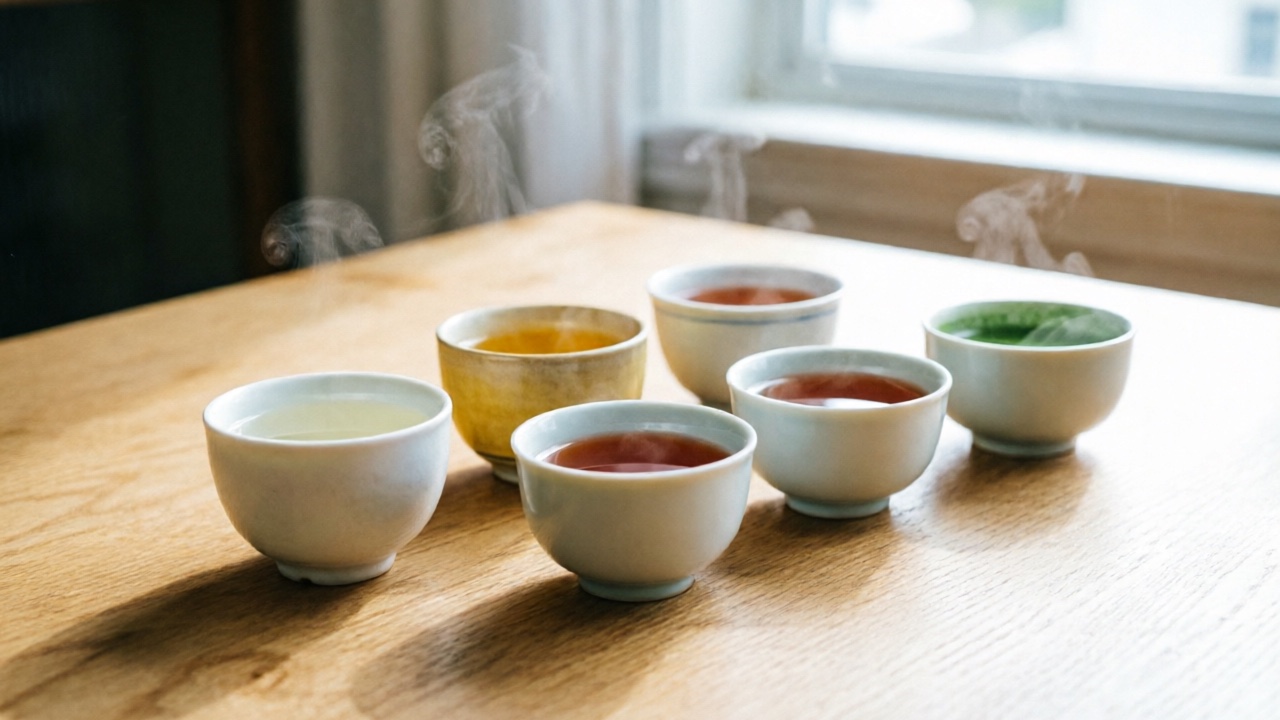
If you have ever wondered whether your afternoon green tea is “stronger” than morning black tea, you are really asking a measurement question. Caffeine by tea type is not a single fixed number. It is a range shaped by leaf form, how much leaf you use, water temperature, steep time, and whether you drink an infusion or the whole powdered leaf.
This page stays in Wellness Tier 1: informational ranges, brew variables, and source-backed comparisons. It is not medical advice. For the broader collection stance, start at the Wellness hub.
Disclaimer: This article is for informational purposes only and is not medical advice. Consult a qualified healthcare professional before making changes to your diet, especially if you are pregnant, nursing, taking medication, or have a medical condition.
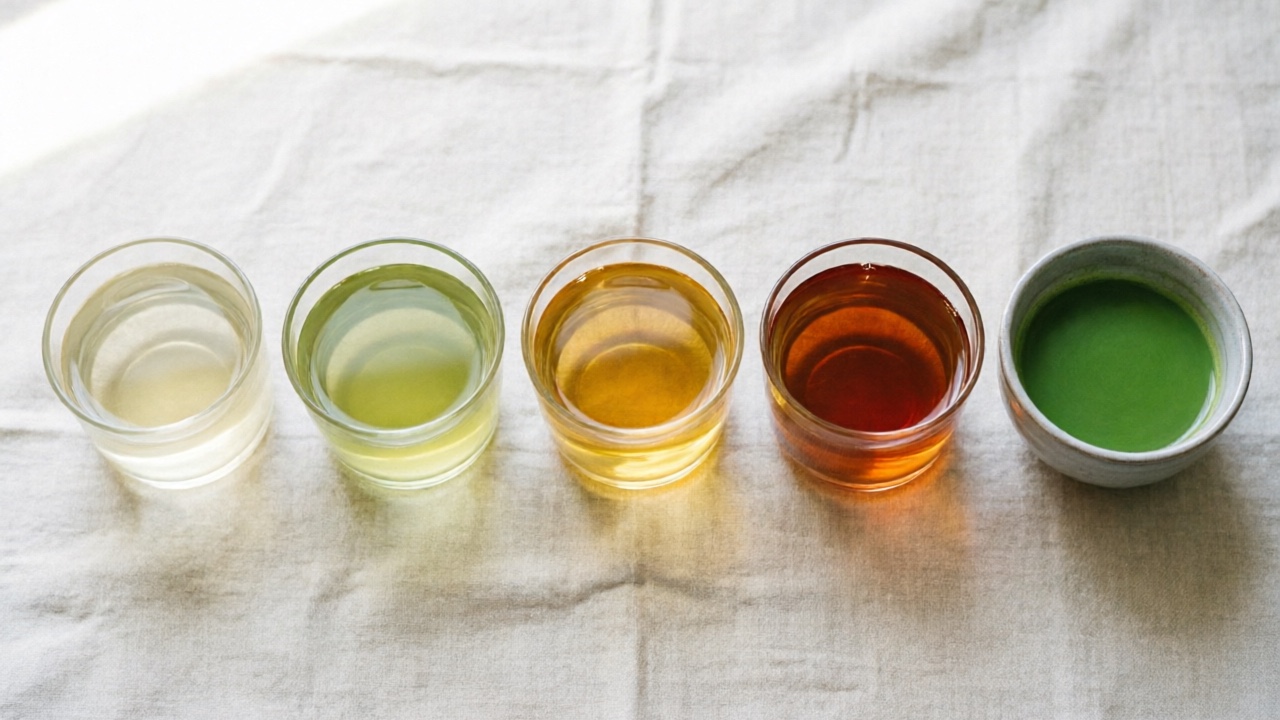
Why caffeine numbers move so much
Public food tables and lab papers rarely measure “one mug of tea” the same way. Some report milligrams per 100 ml of liquor; others report per gram of dry leaf; matcha studies often report per gram of powder because the drinker ingests the leaf itself [1][4].
Three variables dominate home cups:
- Leaf mass — 1 g vs 3 g in the same pot can more than double extracted caffeine.
- Temperature and time — hotter water and longer steeps pull more caffeine from the same leaf [5].
- Form — bagged black tea, loose oolong, and whisked matcha are not comparable cup-for-cup without stating grams.
European Food Safety Authority (EFSA) risk work classifies caffeine as the same compound whether it comes from coffee, tea, cola, or energy drinks; the difference is dose and pattern of intake, not a different molecule [2].
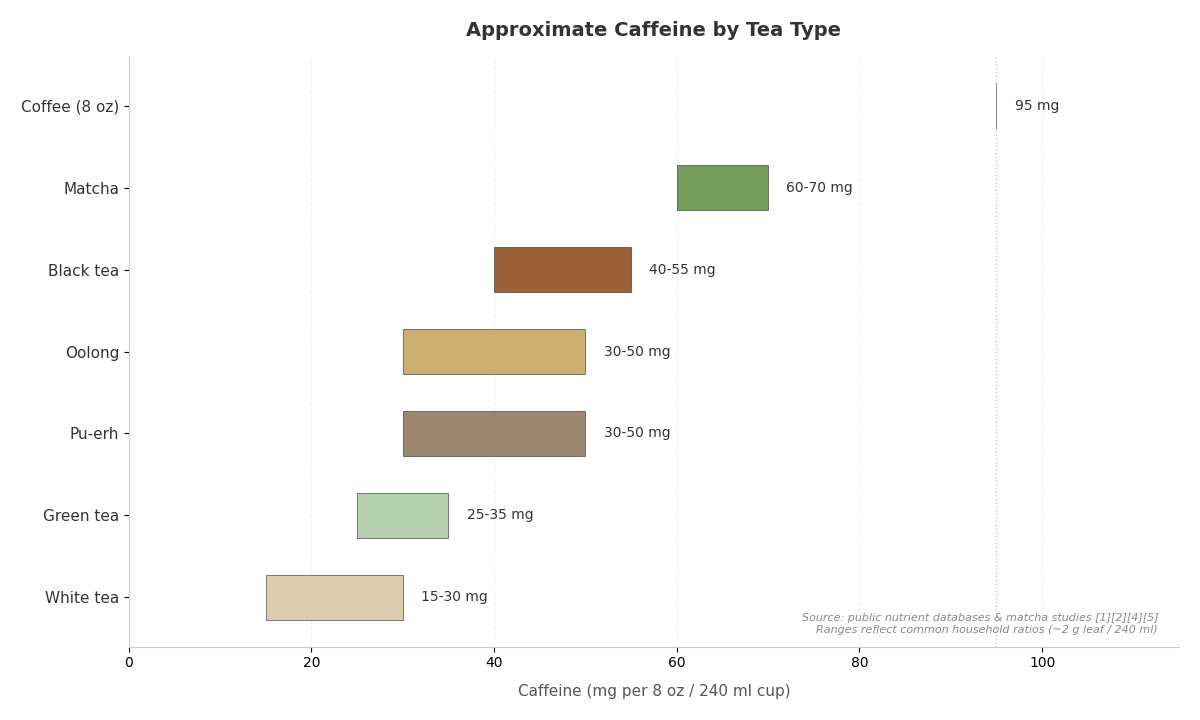
Approximate caffeine by tea type (8 oz / 240 ml style cup)
The table below is a practical home range, not a lab certificate for your tin. Values assume common household ratios (about 2 g leaf / 240 ml for loose leaf; about 2 g powder for matcha) and mid-range brew times. Your scale and kettle still win.
| Tea type | Typical form | Approx. caffeine (mg / cup) | Notes for home brewers |
|---|---|---|---|
| Matcha | Whisked powder | 60–70 (often cited near 70 for ~2 g) | You ingest the leaf; gram size dominates [4] |
| Black tea | Infusion | 40–55 | Often higher than green at equal leaf mass [1] |
| Oolong | Infusion | 30–50 | Oxidation and roast style shift the range [1][5] |
| Pu-erh | Infusion | 30–50 | Ripe vs raw and leaf grade both matter |
| Green tea | Infusion | 25–35 | Cooler water often means milder extraction [1][5] |
| White tea | Infusion | 15–30 | Often lower when leaf mass and time stay modest [1] |
| Coffee (context) | Brewed | ~95 common 8 oz reference | Included only as a familiar benchmark [2] |
These ranges line up with public nutrient databases for brewed teas and with matcha-specific analyses that report caffeine on a per-gram powder basis [1][4]. They are averages and intervals, not prescriptions.
For variety context on powdered green tea, see the Matcha guide and its Where this fits in Mind of Tea map (brewing, teaware, wellness, ceremony). For a classic Chinese green profile that is usually sipped as an infusion (not whisked), compare Longjing.
Matcha vs leaf teas: why the high end looks different
With loose green or black tea, most caffeine stays in the leaf you discard. With matcha, the powder is the beverage. That is why a 2 g ceremonial serving can sit near the top of the tea table even when an 8 oz coffee still measures higher on many charts [2][4].
If you track intake, weigh the powder. A heaping freehand scoop is an easy way to turn a “70 mg day” into a much larger total without noticing.
Practical tools that keep servings honest:
- A small tin you open often, such as Naoki Matcha Superior Ceremonial Blend 40g, works when you measure 1–2 g per bowl.
- For lattes where you may use less powder in a larger drink, Jade Leaf Organic Culinary Grade Matcha is a lower-cost way to practice portion control.
- Heavy daily drinkers who prefer one large tin can keep Matcha DNA Organic Matcha Powder 16oz and still weigh each serving.
Whisking gear does not add caffeine, but it does make 1–2 g servings repeatable. The Hario Matcha Tea Set (Clear) – Double-Walled Glass Matcha Bowl with Chasen Whisk keeps bowl, whisk, and scoop in one workflow. For vessel and tool detail, see Matcha tools. For a milk-forward preparation path, see the matcha latte recipe.
Brew variables that change the number in your cup
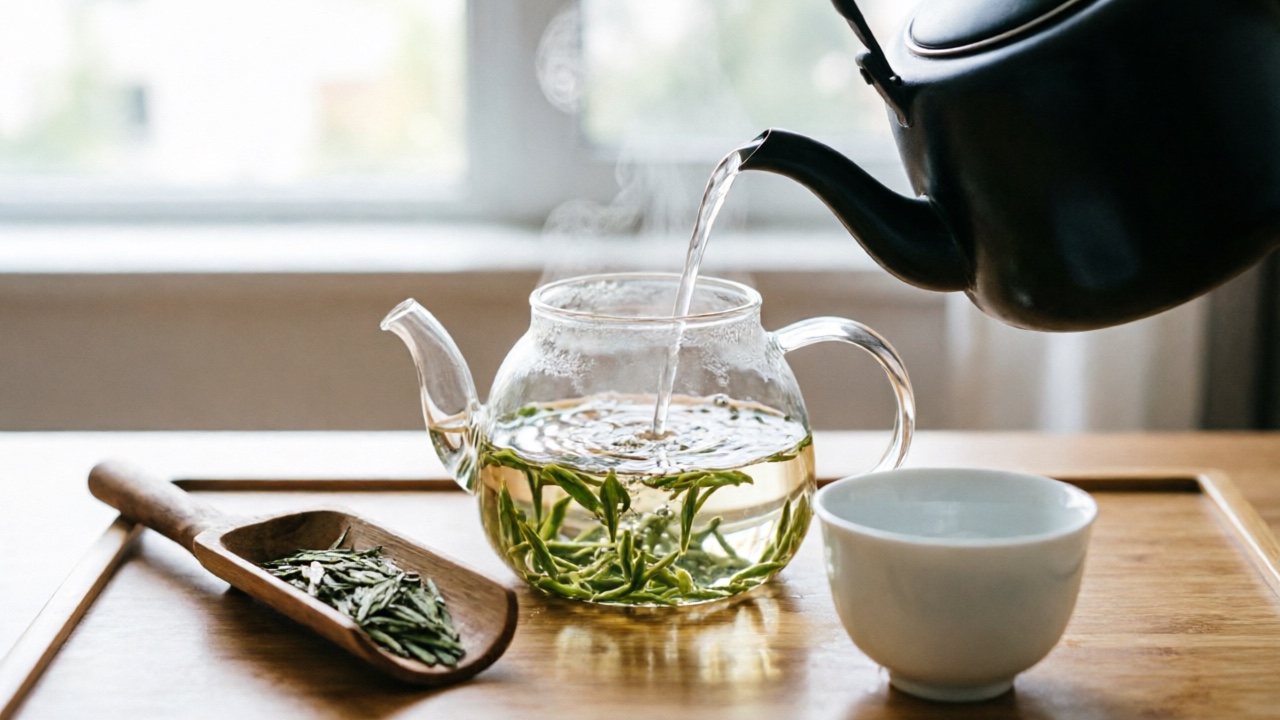
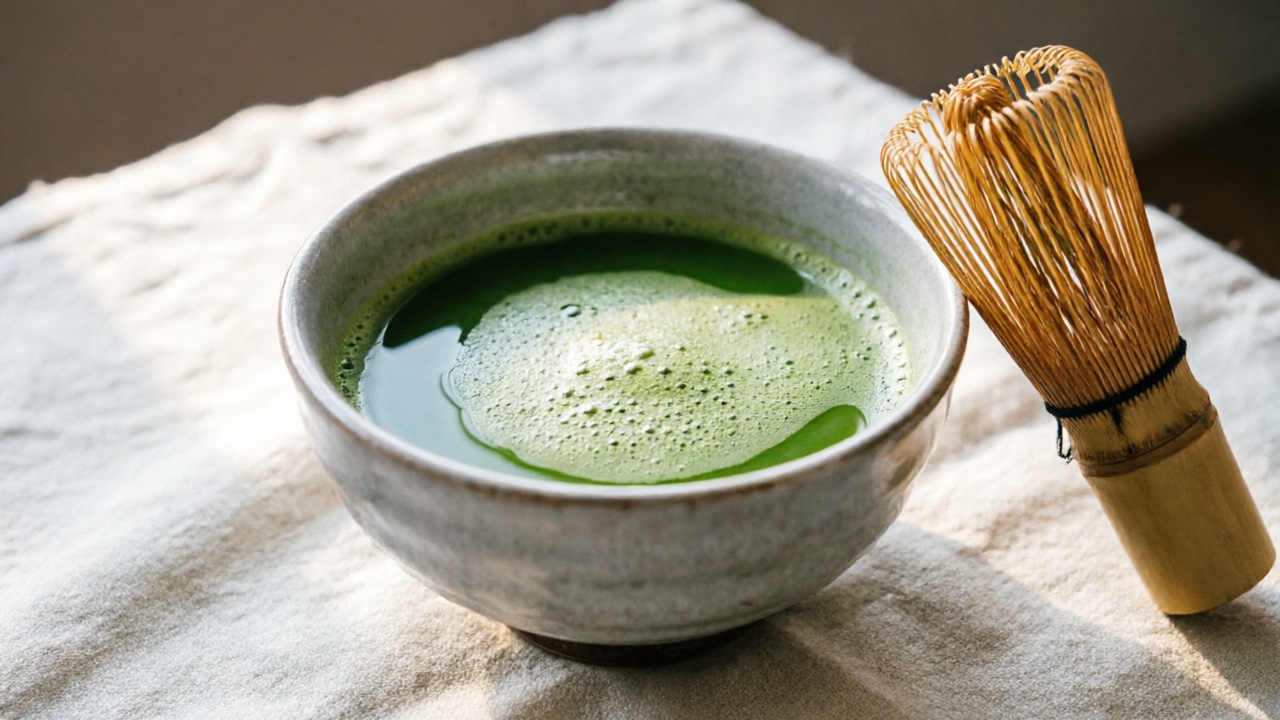
Astill and colleagues summarized a pattern tea drinkers rediscover every week: more leaf, hotter water, and longer contact time increase extracted caffeine from the same material [5]. That is good news if you want a stronger cup — and useful if you want a gentler evening infusion.
Leaf amount
Doubling leaf mass is the most direct way to raise caffeine. If a 2 g green tea bag feels strong, try 1.5 g loose leaf in a mug before assuming “green tea is always mild.”
Water temperature
Greens and whites often taste better below boiling. Cooler water also tends to extract caffeine more slowly than a rolling boil used for many black teas [5]. A variable kettle such as the Cosori Gooseneck Electric Kettle with Temperature Control makes 75–80 °C greens easy to repeat. The Breville BKE830XL IQ Kettle is an optional upgrade if you want presets and a larger capacity for shared pots.
Steep time
A three-minute black tea bag usually lands higher than a 90-second flash steep of the same bag. Gongfu-style short steeps change the curve again: early infusions can be lively, later ones milder, depending on leaf and vessel.
Multiple infusions
Re-steeping the same leaves typically yields less caffeine in later rounds than in the first, though exact drops depend on the leaf and the first steep’s aggressiveness [5]. If you are sensitive late in the day, later infusions are often the calmer choice.
L-theanine is context, not a cure
Tea leaves contain the amino acid L-theanine as well as caffeine. Human studies often examine the pair together when discussing attention and subjective calm; results are mixed by dose and design, and they do not turn tea into a treatment for any condition [3].
Read this section as chemistry context: the same cup can deliver caffeine plus other leaf compounds. It is not a promise about anxiety, sleep disorders, or clinical outcomes. For ceremony-focused pacing rather than milligram math, see the matcha ceremony guide.
Practical checklist: map your daily tea caffeine
Use this as a kitchen checklist, not a medical plan.
- Weigh leaf or powder at least once (1 g, 2 g, 3 g) so “a spoon” becomes a number.
- Write your default: tea type · grams · ml water · °C · minutes.
- Compare that cup to the table ranges above; adjust grams first if you need a lower day.
- Keep matcha scoops at 1–2 g when you want the commonly cited ~60–70 mg band [4].
- Prefer cooler, shorter greens or whites after mid-afternoon if sleep is a concern for you.
- Count coffee, chocolate, and sodas in the same daily total — EFSA’s exposure logic is cumulative [2].
- Store opened matcha sealed and cool so you do not “fix” a bitter cup by over-scooping faded powder.
- When trying a new tin, brew the first cup at your logged baseline before changing three variables at once.
Recommended setup for measured cups
These picks support measurement and brew control. They are shopping tools, not health treatments.
| Goal | Product | Why it helps caffeine tracking |
|---|---|---|
| Ceremonial baseline | Naoki Matcha Superior Ceremonial Blend 40g | Fresh small tin for 1–2 g bowls |
| Budget practice powder | Jade Leaf Organic Culinary Grade Matcha | Lower cost while you learn scoop size |
| Bulk daily matcha | Matcha DNA Organic Matcha Powder 16oz | Large tin only if you still weigh servings |
| Temperature control | Cosori Gooseneck Electric Kettle | Cooler greens / whites on demand |
| Whisk workflow | Hario Matcha Tea Set (Clear) – Double-Walled Glass Matcha Bowl with Chasen Whisk | Repeatable preparation path |
| Optional kettle upgrade | Breville BKE830XL IQ Kettle | Presets for shared pots (optional) |
Beginner vessels beyond matcha are covered in teaware for beginners.
Who should treat these numbers carefully
Caffeine tolerance varies widely. EFSA’s adult guidance discussions around daily intake are population-level risk assessments, not personal targets [2]. Special situations — pregnancy, certain medications, diagnosed sensitivity — belong with a clinician, not a tea chart. Our Tier 3 topic on pregnancy is outlined on the Wellness hub and is not covered here.
Children and adolescents need age-appropriate guidance from caregivers and health professionals; this article does not set pediatric limits.
How to read labels and marketing claims
“High energy matcha” and “gentle evening green” are marketing phrases until grams and brew method appear. Prefer:
- Net weight on the tin
- Suggested serving in grams, not only “1 tsp” without density
- Harvest or grind dates when available for matcha color and flavor (flavor loss is not the same as caffeine loss, but stale powder often tempts larger scoops)
If a page claims tea “detoxes,” “fixes disease,” or “replaces medication,” leave. That language fails basic YMYL hygiene and is not how this site writes wellness copy.
Putting the spectrum to work
A simple weekly pattern many readers can test without drama:
- Morning: black tea or 2 g matcha if you want the higher tea band
- Midday: green or oolong at 2 g / 240 ml with a timed steep
- Late day: white tea or a short second infusion of earlier leaves
Log three days. If sleep or jitters bother you, change one variable — usually grams — before swapping tea types entirely.
The Mind of Caffeine
Caffeine in tea is a range, not a personality trait of a color label on the tin. Grams of leaf, water heat, and steep time write the real number in the cup; matcha sits toward the high end because the powdered leaf stays in the drink. Measure a serving once, brew on purpose the next day, and let calm curiosity — not fear of a chart — set when the kettle comes on.
References
[1] U.S. Department of Agriculture, Agricultural Research Service. FoodData Central. Brewed tea entries (green, black, and related beverages) — caffeine values used as public reference ranges. https://fdc.nal.usda.gov/
[2] EFSA Panel on Dietetic Products, Nutrition and Allergies (NDA). (2015). Scientific Opinion on the safety of caffeine. EFSA Journal, 13(5), 4102. https://doi.org/10.2903/j.efsa.2015.4102
[3] Camfield, D. A., Stough, C., Farrimond, J., & Scholey, A. B. (2014). Acute effects of tea constituents L-theanine, caffeine, and epigallocatechin gallate on cognitive function and mood: a systematic review and meta-analysis. Nutrition Reviews, 72(8), 507–522. https://doi.org/10.1111/nure.12120
[4] Koláčková, T., et al. (2020). Matcha tea: analysis of nutritional composition, phenolics and antioxidant activity. Plant Foods for Human Nutrition (and related matcha composition literature reporting caffeine per gram of powder). Use product labels plus per-gram lab ranges when converting to cup estimates.
[5] Astill, C., Birch, M. R., Dacombe, C., Humphrey, P. G., & Martin, P. T. (2001). Factors affecting the caffeine and polyphenol contents of black and green tea infusions. Journal of Agricultural and Food Chemistry, 49(11), 5340–5347. https://doi.org/10.1021/jf010759+