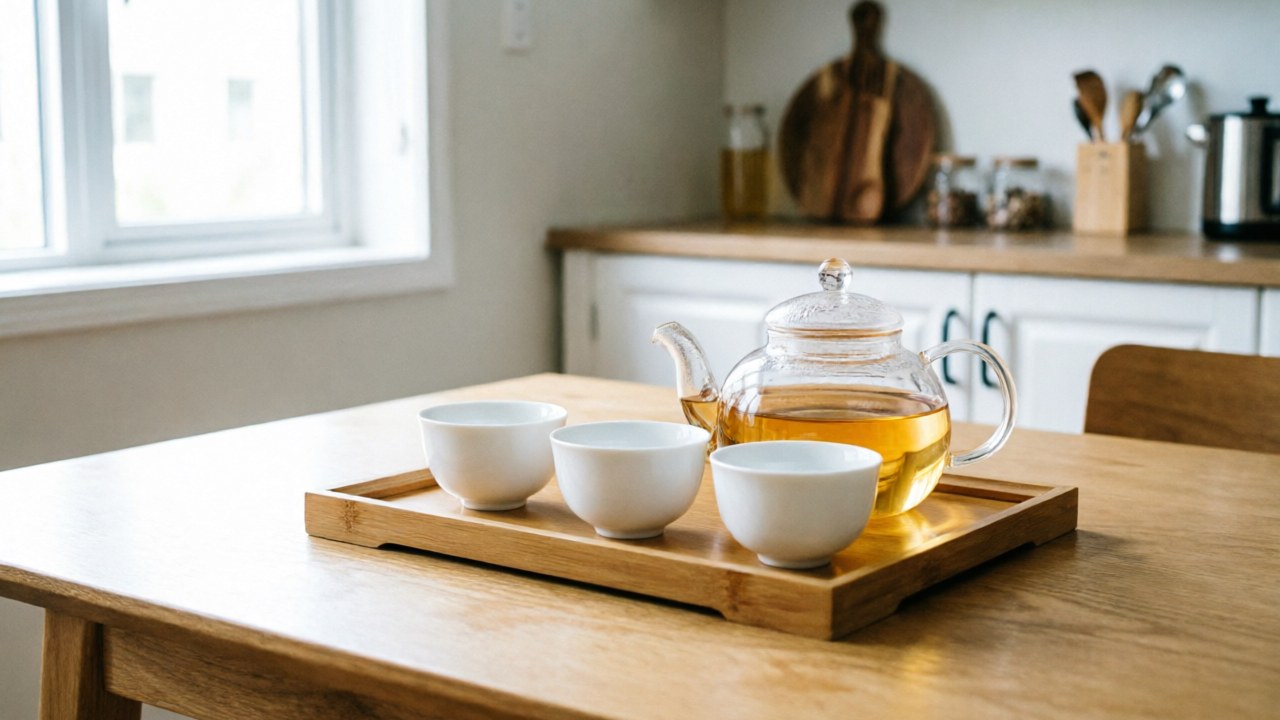
Most “how to serve tea to guests” guides restate cup-handle manners or afternoon-tea tray rules. This one’s a host system for business and home: pick a mode (client, office, or home), choose leaf by occasion, set up by guest count, keep a timing rhythm while people talk, and skip ceremony theater that freezes the room.
Why Occasion Mode Beats Etiquette Charts
Etiquette charts answer “where does the spoon go?” They don’t answer “what do I pour when a client sits down?” Common guides lean on British pour theater, cup-handle pinches, and thermos bag menus — fine for afternoon tea, thin for negotiation or kitchen-table friends.
This is a host decision system: mode → leaf → kit → setup by count → Western pour → optional short multi-infusion → mistakes → tools. It anchors the Tea-for-the-moment Occasions lane. Not Gongfu theater, not Chado, not a party planner.
Pick a Mode — Client / Office / Home
Start with the room, not the fanciest tin.
Client negotiation
Clean black or light oolong. One pot, quiet service, no heavy scent. The cup settles the table; it doesn’t compete with talk.
Office drop-in
Self-serve: black, one green, one herbal. An organizer holds cups, stirrers, and leaf so you aren’t pouring every cup yourself.
Home guests (Western pot)
Two or three tins, shared pot, tray, one preference ask (milk, sugar, lemon, or plain). Keep it small enough that you can still sit down.
Optional — light Chinese-style short pours (small group only)
For 1–3 friends who want flavor layers, short multi-sip pours in a small vessel work. Not a 21-step ceremony, and a poor client default. Foundation: how to brew tea — First cup. Ritual later: tea practice for beginners.
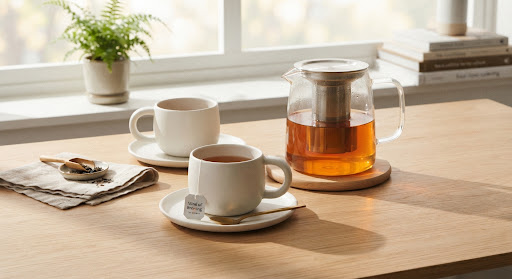
Leaf Selection by Occasion Mode
Match the room, not your collection.
| Mode | Default leaf | Avoid | Why |
|---|---|---|---|
| Client | English Breakfast / clean Keemun-style black | Heavy jasmine, smoke, novelty blends | Familiar, low polarize risk |
| Office | Black + green + herbal sampler | Single expensive tin only | Choice without eight full tins |
| Home | 2–3 tins (black + green + optional oolong) | Twelve open bags | Host focus, not a museum |
| Short pour home | Forgiving black or light oolong | Fragile high-grade green first meeting | Guests talk; heat control varies |
Client default: Harney & Sons English Breakfast loose leaf — a classic Western black blend built for milk-optional table service [1]. Office multi-choice: Tiesta Tea - Discovery Sampler Dry Flight Set. Black profile context (not the same SKU): Keemun black tea.
Tea Map by Client Culture
If you’re hosting clients from different cultural backgrounds, the “default black” rule has nuances. Here’s what works:
| Client background | Safe pick | What to avoid | Why |
|---|---|---|---|
| Western / American | English Breakfast, Earl Grey | Pu-erh, raw greens | Familiar format; milk-compatible |
| Chinese | Tieguanyin oolong or Keemun | Over-steeped bag tea | They expect quality leaf, not bags |
| Japanese | Sencha or hojicha | Smoky Lapsang | Clean, umami-forward profile expected |
| Middle Eastern | Mint-infused green or black | Any dairy-free assumption | Often taken with sugar, sometimes mint |
| Mixed / unknown | English Breakfast | Anything scented or smoked | Lowest polarize risk across cultures |
The key isn’t authenticity — it’s respect. A Chinese client notices instantly if you serve bag tea when loose leaf was available. A Western client doesn’t care about your gaiwan skills but appreciates a fresh, properly steeped pot. For cross-cultural hosting, the Tiesta Tea Discovery Sampler lets guests choose without you guessing. For deeper leaf context, our green tea brewing guide and how to brew black tea cover the specifics.
What You Need — Host Kit
Build by role — not a brand dump.
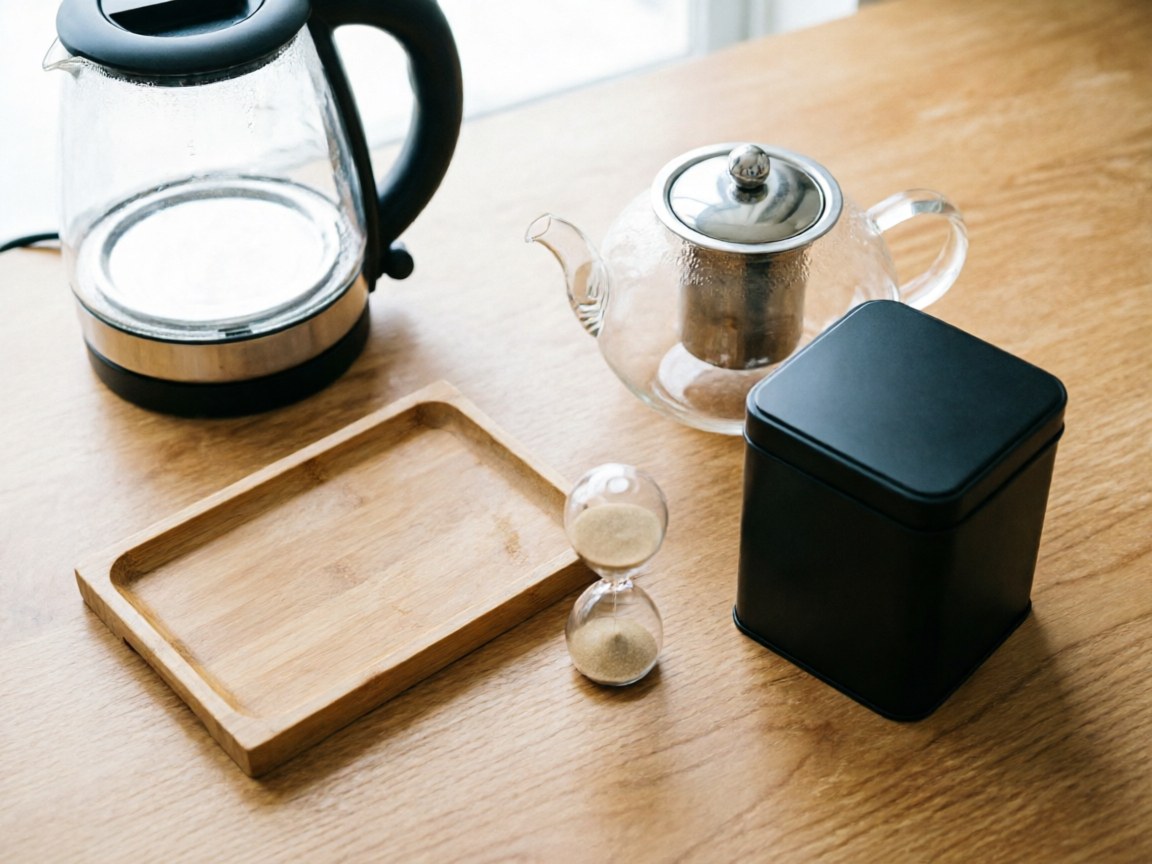
- Heat — temp-control kettle for green vs black guests.
- Share vessel — glass pot with roomy infuser for 2–4.
- Service (optional) — matched white set for formal 4–6.
- Carry — bamboo tray for pot, cups, sugar/lemon.
- Time — silent visual timer on the tray.
- Leaf — default black + office sampler (above).
- Office station — cup and condiment organizer.
Vessel path: teaware for beginners.
Timing & Rhythm in Meetings
When to offer. Pick one primary: open (welcome), mid (reset after a hard topic), or close (soft landing). Re-offer water or a second cup on long sessions only — don’t hover.
Steep while talking. Start the timer when water hits the leaf; remove leaves on time even if talk continues — steeping is the infusion process itself, and bitterness is usually time or heat, not “bad tea” [2]. A tray timer beats a phone alarm mid-deal.
Re-steep vs refresh. One solid Western steep, then refresh leaf for round two. Don’t leave leaves drowning for twenty minutes. Reboiled water also dulls the cup even when leaf and heat are fine [3].
Preference ask once. Milk, sugar, lemon, or plain — then stop. Windows without a chart dump: steeping time guide.
Troubleshooting: Altitude, Cold Tea, and Long Sessions
Three problems that derail hosting tea at the office or during long meetings:
Bitter tea at altitude. Water boils at a lower temperature above 2,000 feet — around 93°C instead of 100°C. Counterintuitively, this means black tea steeps weaker, not stronger. Fix: use slightly more leaf (1.5 tsp per 240 ml instead of 1 tsp) and steep 30 seconds longer. Don’t try to compensate with hotter water — it’s already as hot as it’ll get.
Cold tea in long meetings. A 45-minute session kills a teapot’s heat. Two solutions: pre-warm the pot with boiling water before brewing (pour, swirl 10 seconds, discard), or invest in a double-walled glass carafe that holds heat 2–3x longer than a standard pot. For all-day sessions, brew smaller batches and refresh rather than making one giant pot that goes lukewarm.
Reboiled flat water. Water that’s been boiled, cooled, and reboiled has less dissolved oxygen — your tea tastes flat and dull even with good leaf [3]. Always start with fresh cold water. If your office kettle gets refilled from a hot tap, that’s the problem.
Setup by Guest Count
1–2 guests
Mug or small pot; tray optional; kettle + one tin. A glass pot still helps when you share without ceremony gear.
3–6 guests
Share pot + matched cups; tray required; pre-warm cups. Use the white set, bamboo tray, and kettle from the host kit.
7+ / office open house
Self-serve: organizer, large kettle cycles, sampler. Host circulates; guests pour themselves.
| Guests | Vessel | Tray | Leaf count |
|---|---|---|---|
| 1–2 | Mug or small pot | Optional | 1 tin |
| 3–6 | Share pot + matched cups | Required | 2–3 tins |
| 7+ / office | Self-serve + large kettle | Station block | Sampler set |
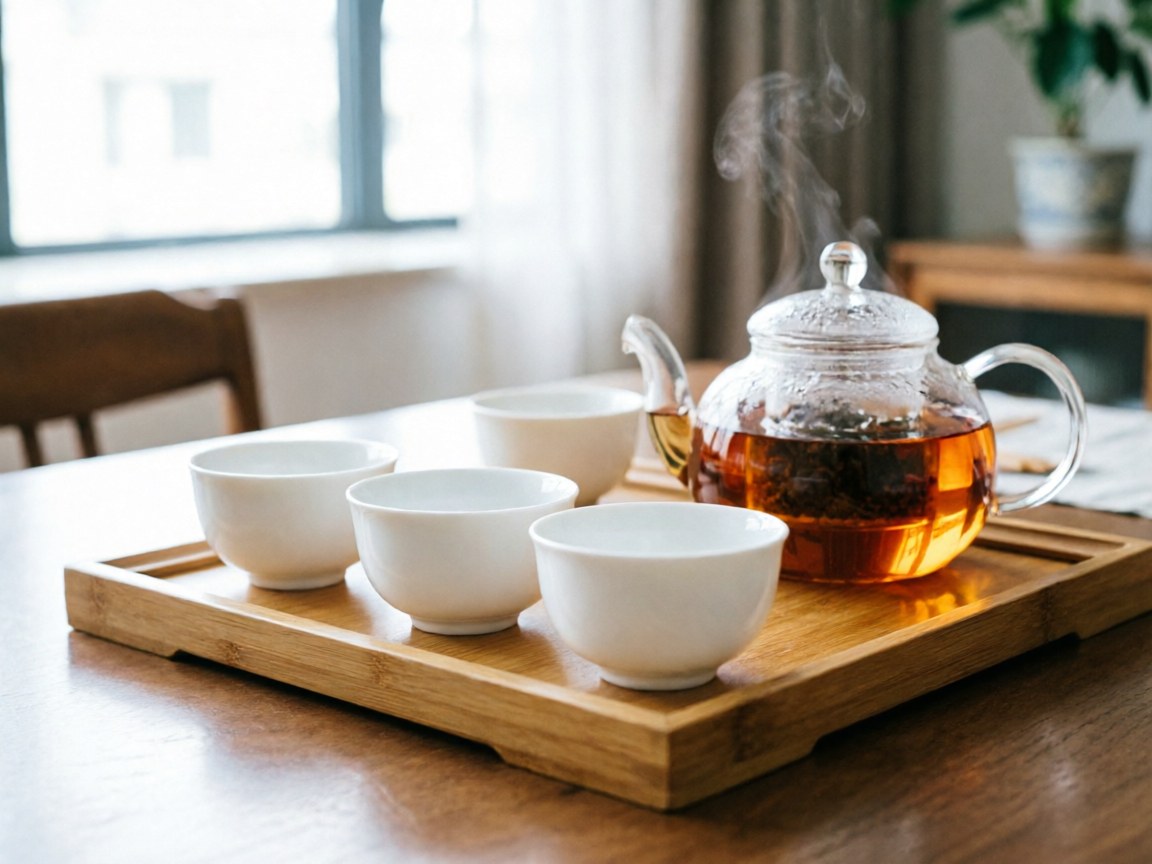
Meeting-Type Scenarios
Different meeting types call for different tea strategies:
1-on-1 client meeting. Keep it simple — one pot, two cups, a quality black tea. The tea is background hospitality, not the agenda. Serve it already steeped so the client doesn’t wait. If they ask for green or herbal, have a backup tin. The Harney & Sons English Breakfast is the reliable default.
Team meeting (4–8 people). Self-serve station with 2–3 options. Set up before the meeting starts so the pour doesn’t eat agenda time. Use the cup and condiment organizer to keep sugar, honey, and lemon tidy. Pre-steep one pot; let people refresh their own cups.
Formal presentation or pitch. Tea should arrive as guests settle — not mid-slide. One pre-poured cup per setting on the tray signals preparation without interrupting the flow. Skip re-offers during the pitch; the cups are props for comfort, not refill stations. If the session runs 90+ minutes, a single mid-point refresh is appropriate.
All-day workshop. Rotate: black for morning, green for afternoon, herbal for the post-lunch slump. Keep a sampler set on the station so people self-select. Brew in small batches — better to refresh three times than serve one cold pot. See our occasion focus guide for desk-friendly setups.
Western Host Pour Steps
Kitchen-table steps — not ceremony.
- Heat water to type (black near boil; green cooler) with the temp-control kettle.
- Warm pot and cups with a quick rinse.
- Dose by pot size — about 1 tsp denser black per 240 ml; fluffier greens need more volume. Skill, not law; leaf-to-water ratio calculator helps when pot size changes.
- Steep timed with the visual timer; remove infuser or leaves on time.
- Carry on the tray; pour guest first, host last — or self-serve for office.
- Preference ask once; re-offer only on long sessions.
Glass pot for easy share; formal white set when matched service matters. No Gongfu rinse theater.
Optional Short Multi-Infusion at Home (Not Full Gongfu)
Only for 1–3 friends who want flavor layers and a small vessel. Higher leaf load, short pours (10–40s), small cups — home practice, not a business default. Vessel tree: how to brew tea. Ritual path: tea practice for beginners. Don’t use it as the primary client mode — timing costs too much in negotiation.
Tea Rotation for All-Day Hosting
If you’re hosting from morning through afternoon, a single tea won’t carry the full arc. Energy levels shift, palates fatigue, and the same cup that felt right at 9 a.m. falls flat by 3 p.m. Here’s a rotation that works for workshops, retreats, or all-day client visits:
Morning (9–11 a.m.): Black tea. The caffeine lift and bold flavor match the energy of a fresh start. English Breakfast or a clean Keemun sets a professional tone. Steep strong enough for optional milk — about 1 tsp per 240 ml, 3–4 minutes.
Midday (11 a.m.–1 p.m.): Oolong transition. A medium-roast Tieguanyin or lighter Dancong bridges between the morning black and the afternoon green. Oolong’s complexity gives people something to talk about during a lull. If you don’t have oolong on hand, a second pot of black works fine — the rotation is enhancement, not requirement.
Afternoon (2–4 p.m.): Green tea. Lower caffeine, fresh profile. This is where FGO Organic Jasmine Pearl ($10.99) shines — the floral aroma resets a room that’s been sitting since lunch. Brew at 75–80°C, 1–2 minutes. For the science behind why green tea feels different from coffee, our tea and meditation guide covers the L-theanine angle.
Late afternoon (4 p.m.+): Herbal or white. Caffeine-free options signal winding down. A rooibos or chamomile lets people self-serve without worrying about sleep later. If the group prefers real tea, a light white tea at 70°C delivers minimal caffeine with a clean finish.
The rotation isn’t about impressing guests with variety — it’s about matching the tea to the energy curve of the day. One well-timed switch (black to green after lunch) does more than four mediocre options on a station.
Common Host Mistakes
- Oversteep while talking → bitter cups → silent timer on the tray.
- Scented / novelty tea for first client meeting → polarize → default English Breakfast black.
- Overcrowded ball infuser → weak, stewed leaf → roomy glass pot basket.
- Reboiled flat water → dull liquor [3] → fresh cold fill each cycle (temp-control kettle).
- Ceremony theater that freezes guests → Western pour + one preference ask.
- No tray / multiple trips → bamboo tray.
- Office with zero choice → sampler + station organizer.
Tools Recommended by Role
Same eight SKUs. Re-link the two roles most hosts under-buy:
- Heat: temp-control kettle
- Timer: sand tea timer
Share pot, formal set, tray, client black, office sampler, and station organizer sit in Host Kit and Mistakes — no new ASINs.
Where to Go Next
This page anchors Occasions on the Brewing hub (#occasions). First cup: how to brew tea. Special cups: matcha latte recipe. Teaware: hub, beginners, personal system. Black depth: Keemun. Tools: steeping time, brewing ratio. Ceremony only if guests want ritual: tea for beginners.
The Mind of Hosting
Hosting is not a performance. Offer a clean cup at the right moment, match the leaf to the room, and keep the pour simple while people talk. A timer on the tray beats perfect manners with bitter tea. When the cup is shared without ceremony theater, guests relax — and the meeting, or the evening, can actually begin.
References
[1] Wikipedia contributors. “English breakfast tea.” Wikipedia. https://en.wikipedia.org/wiki/English_breakfast_tea
[2] Wikipedia contributors. “Steeping.” Wikipedia. https://en.wikipedia.org/wiki/Steeping
[3] UK Tea & Infusions Association. Everyday brew guidance (fresh water, timed steep). https://www.tea.co.uk/